
Ecological History of Dartmoor and the Cause of Degradation
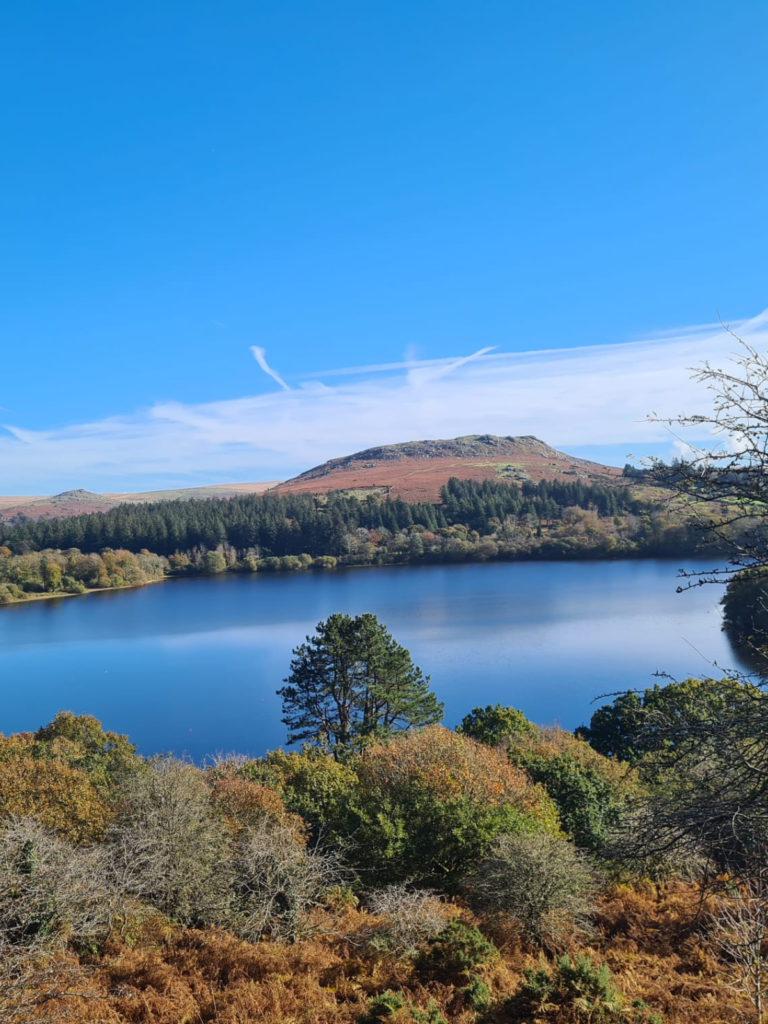
The history of Dartmoor begins in the Carboniferous period 300 Million years ago when it was formed (Simmons, 2019), however its ecological change began 12,000 years ago before human interference (Dartmoor National Park Authority, 2009). After people began to settle around the area for its abundant supplies of wood and game, areas of forest were cut into clearings, using primitive tools and fire to encourage animals to graze. It was this debris from the burning and forestry that lead to the formation of thefirst peat bogs on Dartmoor. (Dartmoor National Park Authority, 2009).
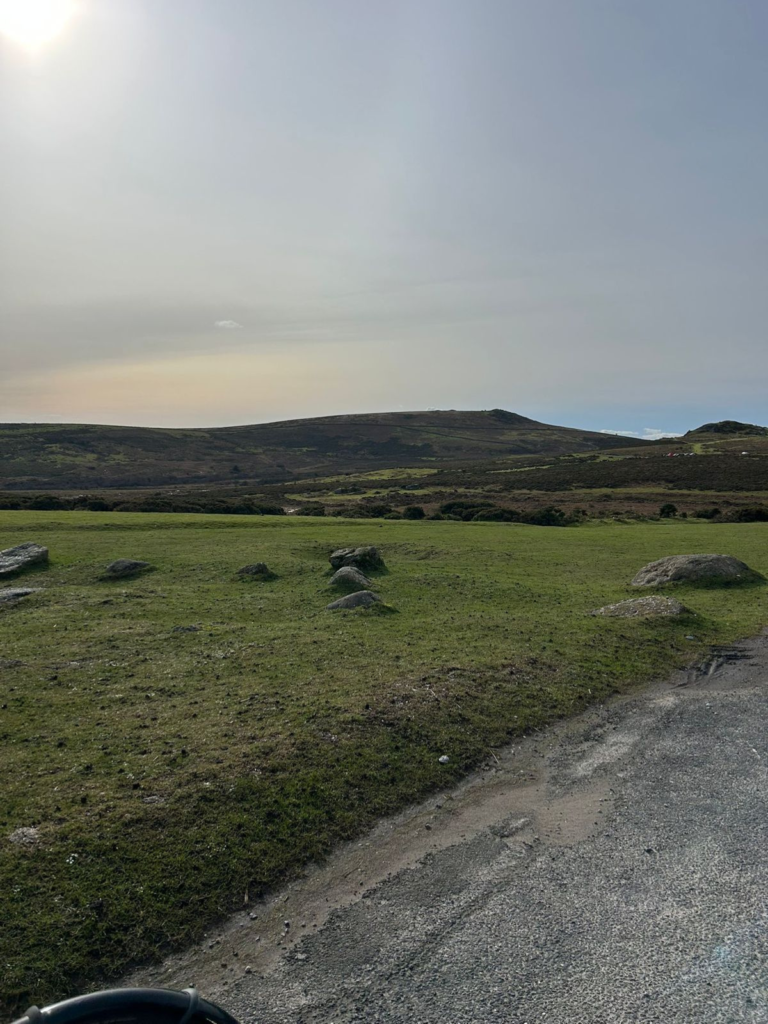
It was this burning and grazing which also gave way to the rise in degradation across Dartmoor, with the creation of peat bogs, which according to Keddy (2023) has increased in depth by 1mm each year. This is one of the factors that affected the degradation of Dartmoor, as with an increase in peat, there was a rapid increase in the soil’s acidity (Harrod Et Al, 2015). Combine this with the deforestation for grazing and the increase agricultural movement along the moors, the soil became inhabitable for large species and could only sustain smaller grass suitable for grazing (Sillitoe, 2021).
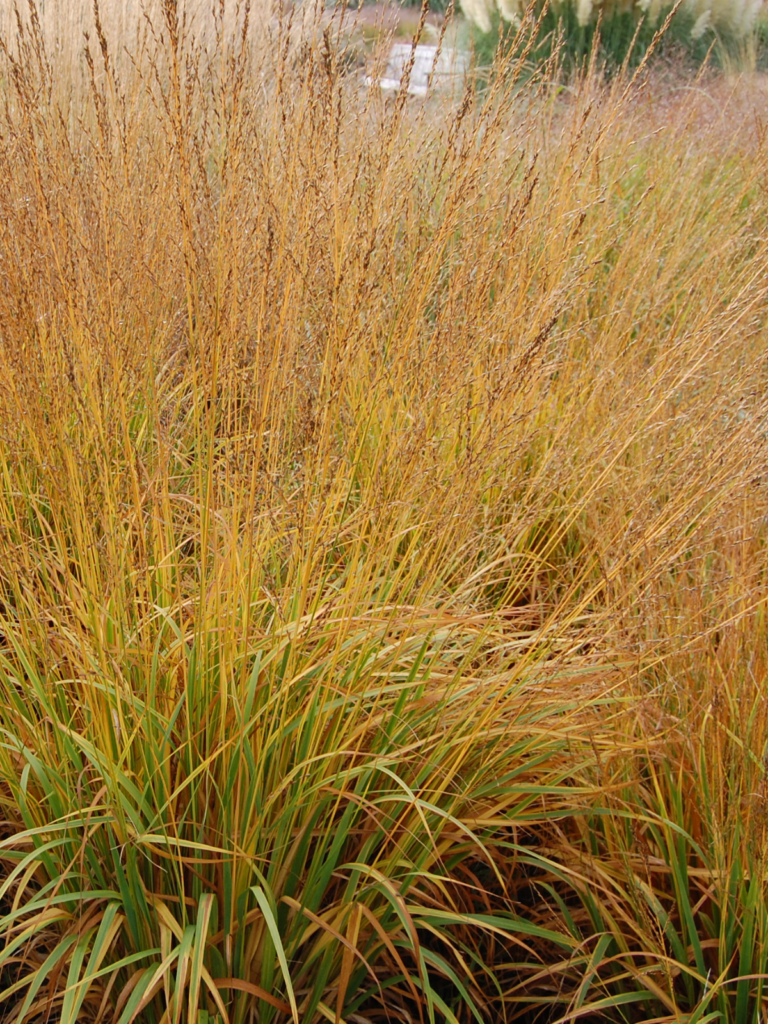
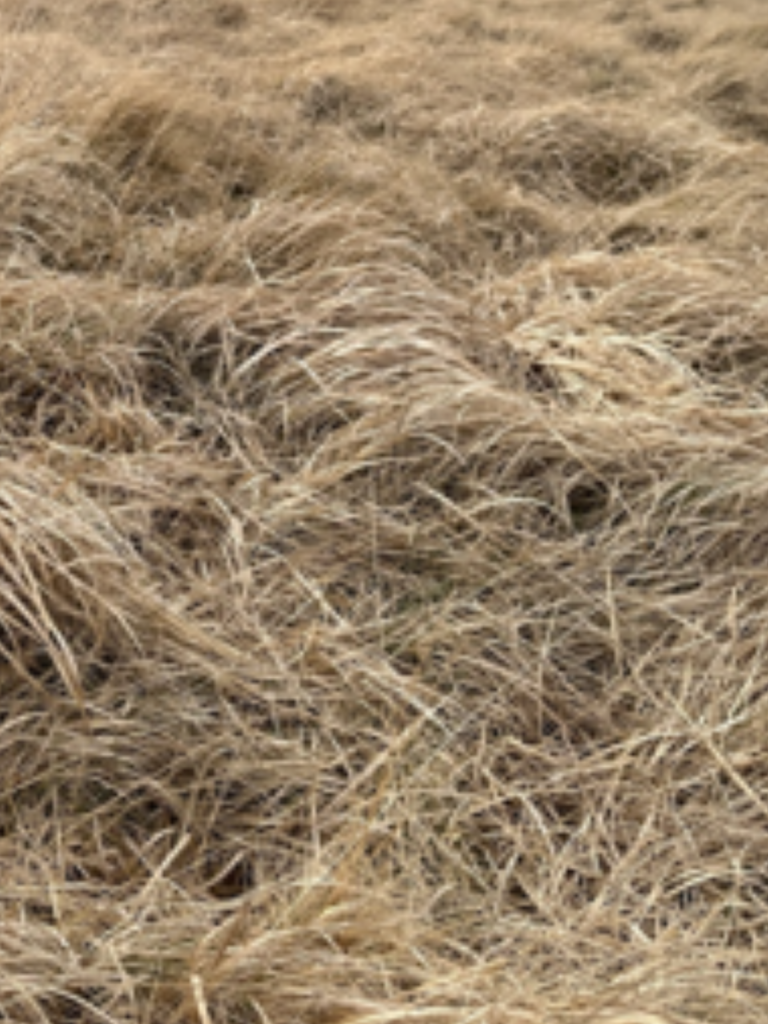
Currently, most of Dartmoor is made up of multiple different Grass types such as: Bristle Bent, Common Bent, Sheep’s Fescue, Mat Grass and the widely spreading Purple Molinia Grass (Dartmoor.gov, 2017). All of this grass currently dominates the national park and grows over a thin layer of acidic mineral topsoil and shallow peat bogs. In the Dartmoor Molinia Report (Bruce, 2025), the spread of the invasive Molinia is caused by the reduction in grazing animals along the moors, while it is the reason that there has been degradation in Dartmoor’s ecology, it has now become vital to stop the growth of molinia purple grass. Alongside the increase in nitrogen deposition from the atmosphere, Molinia grass has created dense tussocks that are difficult to remove and prevent the regeneration of other native grass species that live along the moors.
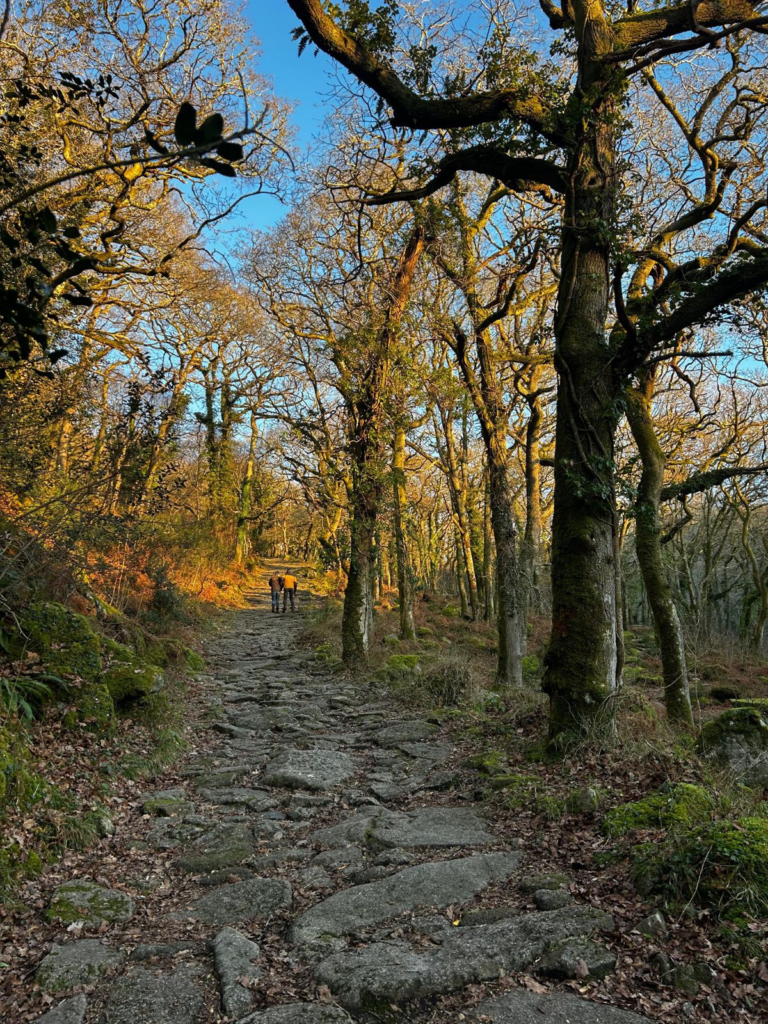
The Mission
We are fighting to reclaim our landscape. Molinia caerulea (Purple Moor Grass) now covers 70% of the Forest of Dartmoor, creating impenetrable tussocks that stifle biodiversity. To plan our 10-year restoration trials with the Duchy of Cornwall, we’ve analysed remote sensing data (Harmonised Sentinel-2 Surface Reflectance satellite data) spanning 2019 to 2025 (European Space Agency [ESA], 2026) to track this invasion (See figure 1).
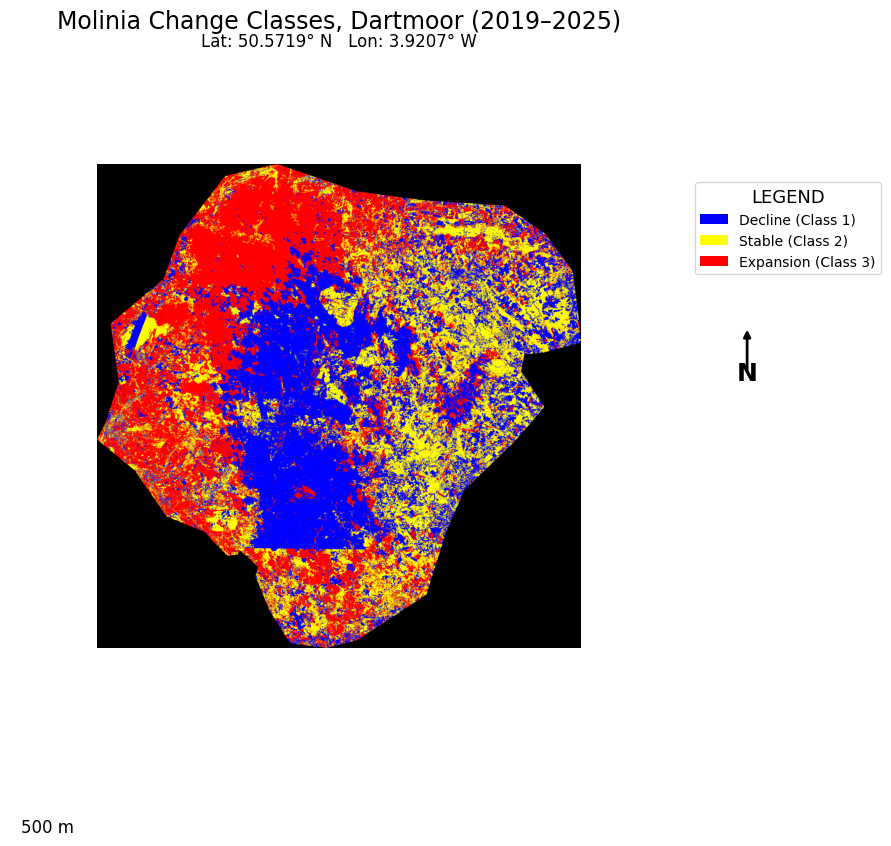
The blue areas (Class 1) represent where the grass is naturally retreating and allowing vital heathland to recover. In contrast, the yellow areas (Class 2) map out where the grass has formed stubborn, impenetrable clumps that block out native plants and restrict cattle and sheep. Finally, the alarming Red areas (Class 3) highlight the active frontlines where Molinia is aggressively spreading, underlining the urgent need for our new management trials to protect the moor’s biodiversity, carbon-storing peat, and traditional farming heritage.
To tackle the Molinia menace, we first need to track it using the Normalised Difference Vegetation Index (NDVI). NDVI is a remote sensing metric that acts like a plant health scanner. Healthy, lush vegetation absorbs red light and strongly reflects near-infrared (NIR) light. In the summer, Molinia is vibrant and green, resulting in high NDVI scores. However, by winter, it dies back into thick, impenetrable dead litter, causing its NDVI score to plummet near zero. To achieve this, we analysed the Harmonised Sentinel-2 Surface Reflectance satellite data between 2017 and 2026 (European Space Agency [ESA], 2026).
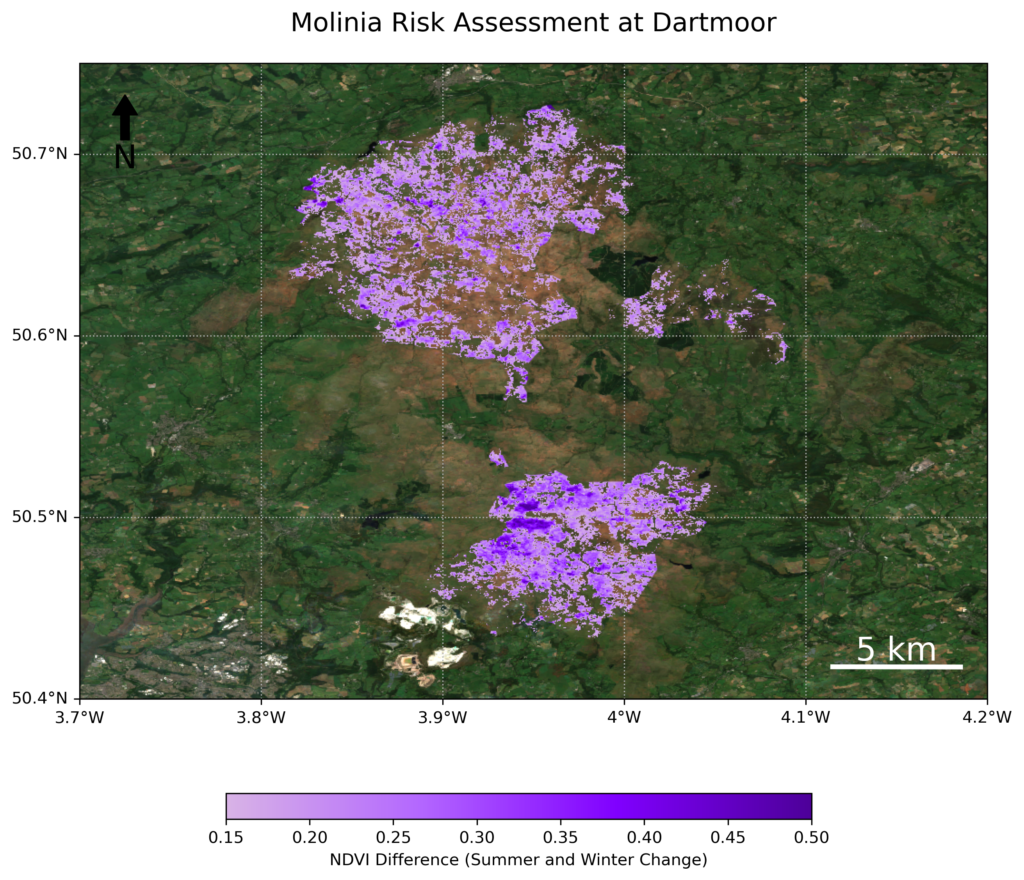
We tracked this drastic seasonal swing using remote sensing analysis represented on the Molinia Risk Assessment Map (See figure 2). By measuring the exact difference in NDVI between the summer peak and the winter die-off period, we successfully isolated the Molinia across the landscape. On the map, the deep purple zones expose the hotspots. The darker the purple, the more severe the seasonal die-back, highlighting exactly where the grass has completely taken over the ecosystem.
Degradation
Over the last 50 years, the spread of invasive Purple Moor Grass (Molinia caerulea) across Dartmoor has grown to dominate large areas of moorland. Below is an outline of some of the social, environmental and economic challenges the spread of Molinia brings.
Environmental Impacts
Biodiversity Loss
Designated as a protected conservation area with a number of ‘sites of special scientific interest, it is critical that Dartmoor maintains as much biodiversity as possible to help support the conservation of endangered British species. Unfortunately, due to its impressive adaptations and rapid early growth stage, where Molinia establishes itself, it quickly outcompetes other plant species and reduces habitat diversity for local animal species.
In areas without Molinia dominance, Dartmoor is home to a wide range of birds, invertebrates, mammals, and plant life. Included in its impressive list of species is the only breeding colony of the Ring Ouzel Bird in Europe and national strongholds of many insect species, including the Southern Damselfly and Marsh Fritillary Butterfly!
Loss of Ecosystem Resilience
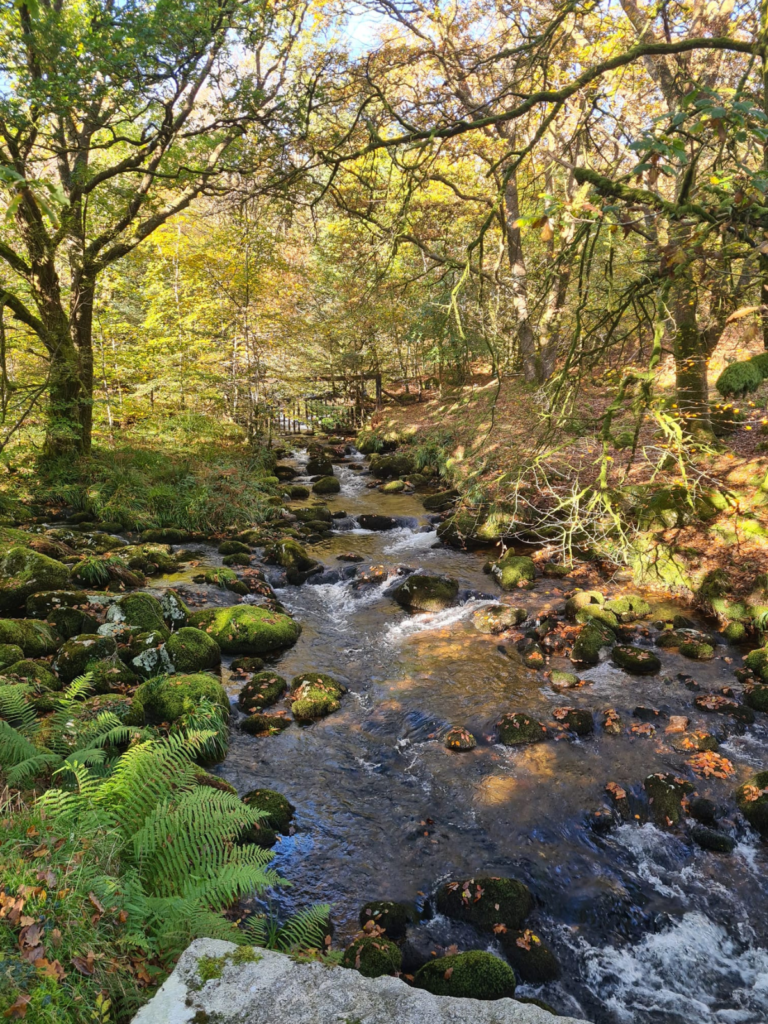
Overdominance of a single species in any ecosystem decreases its resilience to diseases, pests, and extreme weather events, but in Dartmoor specifically, an overdominance of Molinia has created a drastic increase in fire risk. During the summer months dense Molinia growths create layers of dry litter, which dramatically increases fuel load for wildfires becoming increasingly common in drier climate change-driven summers. These fires can burn into the already fragile peat ecosystems native to the area, reducing carbon storage and leaving long term scars on the habitat.
Loss of Peatlands
Much of the Dartmoor land is made-up of degraded peatland which creates an ideal nutrient-rich habitat for Molinia growth, which unfortunately accelerates further peatland degradation.
Although little known to the public, healthy peatlands are important natural carbon stores, water filtration systems, flood and drought managers and wildfire protectors. If an increased growth of Molinia means a decrease in healthy peatland then we need to act soon!
Social and Economic Impacts
Farming and Commoning
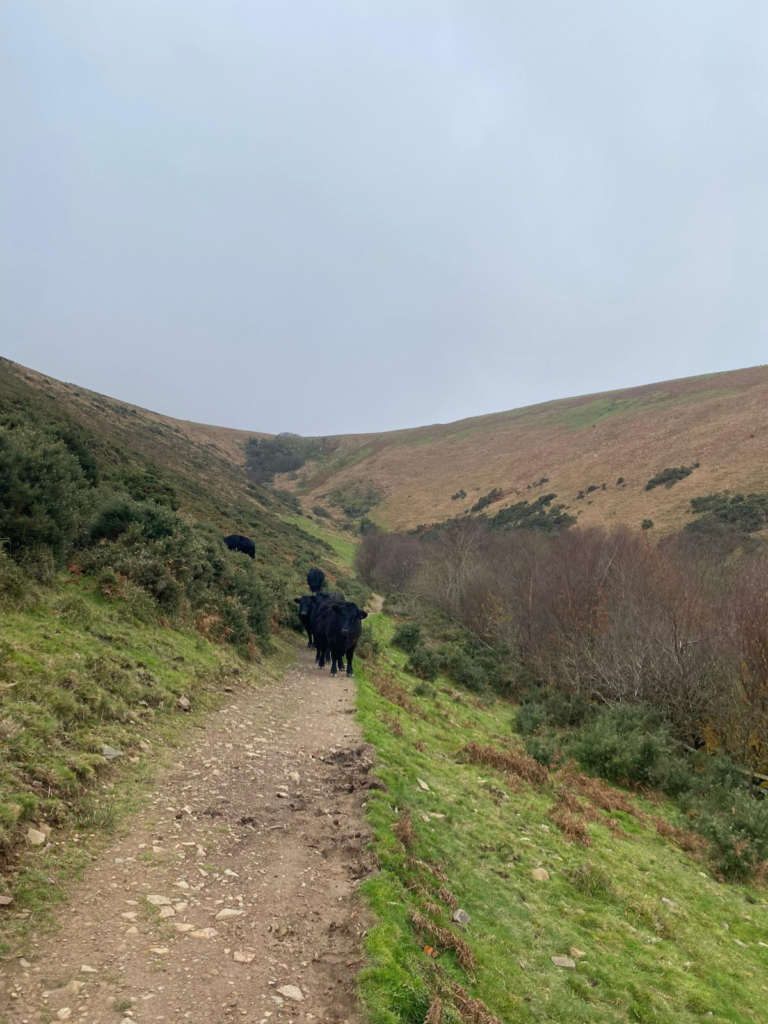
Dartmoor has been continuously farmed for over 5000 years, used as a grazing site for cattle, sheep, and ponies. However the dense formations of Molinia make it difficult for animals to move across the land, and the plant itself is unpalatable to most grazing animals, making it inappropriate feed. As a result, a growing area of Dartmoor has become unproductive and unfarmable, and grazing is forced into smaller sections of land. This creates a high risk of overgrazing that can further damage the ecosystem and threaten the wildlife and traditional farming practices that shape the Dartmoor land.
Public Access and Enjoyment
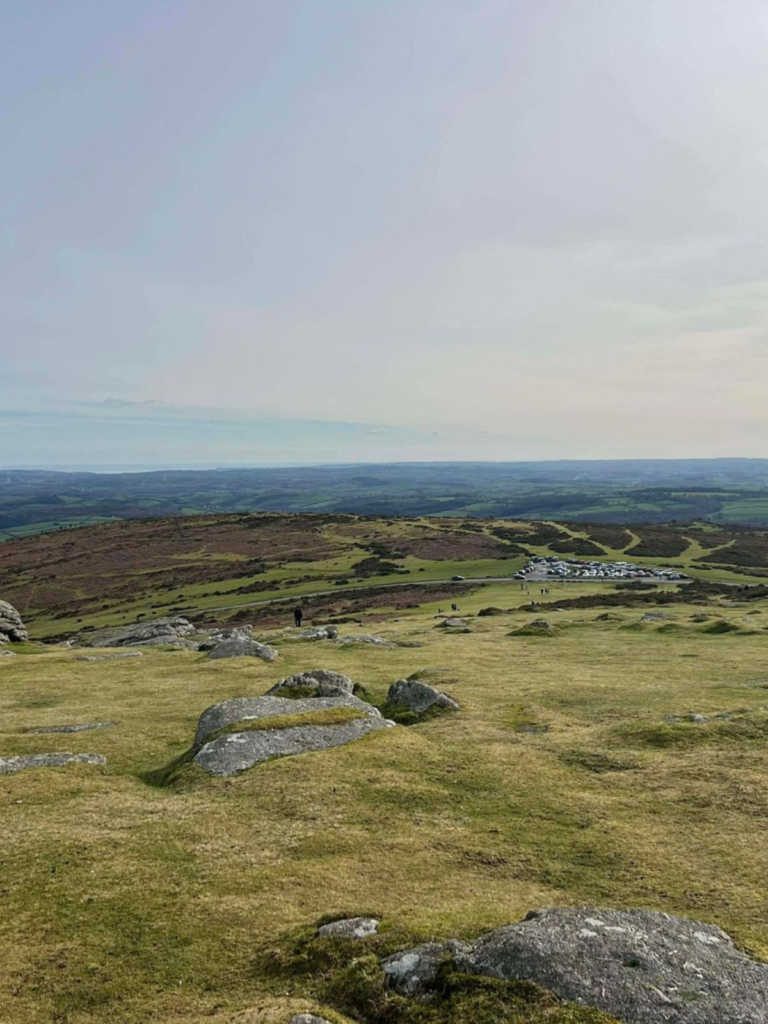
Tall dense growths of Molinia make the much-loved public footpaths of beautiful Dartmoor difficult to navigate, quicker to erode and less enjoyable to explore. A reduction in Molinia would increase the accessibility of Dartmoor to walkers, and help to support the special views and species people travel to see.
Archaeology
Molinia growth across Dartmoor is becoming an increasingly recognised challenge for archaeologists too, with large mats of overgrown grass making it difficult to survey, find and maintain important archaeological sites across the conservation site.
Management
Although Molinia is native to the UK it behaves invasively across Dartmoor. Thriving off increasing levels of nitrogen in the soil, Molinia grows in thick high tussocks with deep roots across bog and peatland, overwhelming and outperforming other plant species. As the grass grows thicker and taller it becomes increasingly difficult to manage; it is unpalatable to the majority of grazing species, resistant to the areas’ traditional burning methods of plant management – in fact this stimulates growth, and the thick layer of litter it creates blocks the growth of competing plant species, allowing it to establish a monoculture style dominance.
In order to return areas of Molinia-dominated land across Dartmoor into productive, farmable, and enjoyable territory management strategies need to be implemented soon. So, what options do we have?
A. Grazing
Grazing the Molinia in the spring when the shoots are younger is one option to help manage its overgrowth. At this time of year, the plant is more palatable, and by rotating grazing animals through the area with GPS collars or fences overgrazing can be prevente
Grazing the Molinia in the spring when the shoots are younger is one option to help manage its overgrowth. At this time of year, the plant is more palatable, and by rotating grazing animals through the area with GPS collars or fences overgrazing can be prevented.
Benefits:
- Helps to support traditional farming practices and communities
- Grazing helps to create gaps within the landscape for different species to develop
- Trampling by grazing animals also helps break up tussocks and turn over soil for new species to grow
Challenges:
- Grazing has to be kept up consistently or Molinia will grow back stronger!
- There is disagreement over the best times of year to graze, and whether land should be grazed overwinter too
- May require a change in the typical breeds used for grazing, with a focus on hardier breeds that can help trample the grass when it is overgrown
B. Cutting or Flattening
Manually cutting Molinia or flattening it with diggers can help to suppress growth and reduce the amount of organic litter that accumulates on the moors ground. This helps light to reach the underlying soil for new plant species to grow.
Benefits:
- Helps clear a path for grazing animals and walkers
- Comparably quick results compared to other methods
Challenges:
- Biomatter needs removal
- Process needs repeating annually and is unlikely to be successful alone and Molinia will regrow each spring
C. Controlled Burning
Burning or ‘swaling’ Molinia during the winter is a traditionally used practice to help manage Dartmoor’s land. Small winter burns can help to break up areas of Molinia growth to make way for other activities.
Benefits:
- Opens up land for grazing
Challenges:
- Burning on peatland can cause irreversible ecosystem damage and loss of carbon stores
- Mature Molinia is largely fire-resistant and grows back stronger after fires as all competition is removed
D. Rewetting
Rewetting the underlying peat bogs of Dartmoor could help to challenge Molinia growth while helping to restore Dartmoor’s functioning ecosystem and its services as Molinia does not grow well in standing water.
Benefits:
- Restored peatlands would increase carbon storage, erosion resilience and natural flood management
- Creation of a rare habitat type for endangered invertebrate and bird species
Challenges:
- Rewetting would be a long-term and difficult project involving blocking drainage ditches and raising water tables.
The challenge of overcoming Molinia’s increasing dominance is complex, political, and expensive. It is likely that in order to effectively remove Molinia from different landscapes across Dartmoor, a combination of some of the above management techniques will be most effective for restoring long term land productivity, biodiversity and ecological function.
The Great Dartmoor Molinia Debate
Why can’t experts agree? Here’s the evidence from real Dartmoor trials:
Debate 1: Grazing, Too Little Or Too Much?
“More grazing is the answer.”
Commoners point to Swincombe Valley trials where Dartmoor ponies cut Molinia cover by 35% and restored 15% more heather in just three years. Ponies trample tussocks that sheep avoid, allowing room for desirable plants (Lunt et al., 2021; Dartmoor Preservation Association, 2025a).
“Grazing caused the problem.”
Conservationists reference Northern Moor SSSI. There, reducing cattle numbers by 20% led to an 18% decline in Molinia and recovery of dwarf shrubs. Past overgrazing created bare ground, which allowed Molinia to spread (Natural England, 2024).
The evidence clash:
Swincombe shows that targeted grazing works, but Northern Moor indicates that rest periods are needed first. Multi-species approaches that mix ponies, cattle, and sheep appear most promising (Colston, 2025).
Debate 2: Swaling, Essential Tradition or Carbon Risk?
“Controlled burning works.”
Postbridge farmers successfully used post-harrowing burns to double heather regrowth rates by clearing Molinia litter. This 500-year tradition works when done in small, wet patches (Dartmoor Preservation Association, 2025a).
“Fire threatens peat carbon.”
A University of Exeter assessment of Northern Moor grip blocking found swaling bans cut CO₂ emissions by 25% as elevated water tables prevented peat drying and combustion. Uncontrolled fires already destroyed 10 ha of peat (Benaud et al., 2024).
The evidence tension:
Micro-burns boost short-term biodiversity, but long-term carbon storage demands wet peat protection first.
Debate 3: Who Pays for Restoration?
“Farmers bear the cost.”
Postbridge Duchy trials cost £5k per hectare upfront but resulted in 12% heavier sheep within 18 months. Commoners fund 80% of grazing management themselves while Natural England focuses on biodiversity metrics (Colston, 2025).
“National priorities come first.”
Government schemes support grip blocking but link payments to strict monitoring, delaying farmer assistance. The 13.1 megatonnes of peat carbon in Dartmoor justifies public investment (Natural England, 2024).
Local voice: “They want fixed commons but fund few stock,” said a Postbridge commoner (Forest of Dartmoor Commoners Association, 2024).
References
Albertson, K. et al. (2009) ‘Forecasting the outbreak of moorland wildfires in the English Peak District’, Journal of Environmental Management, 90(8), pp. 2642–2651. Available at: https://doi.org/10.1016/j.jenvman.2009.02.011.
Benaud, P. et al. (2024) Progress of peat restoration on Dartmoor. University of Exeter. Cited in: Dartmoor Society (2024) New report from Exeter University on the progress of peat restoration on Dartmoor. Available at: https://dartmoorsociety.com/new-report-from-exeter-university-on-the-progress-of-peat-restoration-on-dartmoor/ (Accessed: 26 February 2026)
Bruce, H. (2025) ‘Molinia Management Report – Dartmoor Preservation Association’, 7 July. Available at: https://dartmoorpreservation.co.uk/molinia-management-report/ (Accessed: 4 March 2026).
Colston, A. (2023) Coping with Molinia grass in Dartmoor, and thoughts on Dartmoor’s future – a view from Adrian Colston, Foundation for Common Land. Available at: https://foundationforcommonland.org.uk/commons-stories/molinia-dartmoor-adrian-colston (Accessed: 3 March 2026).
Colston, A. (2025) Dartmoor’s Molinia management trials. Available at: https://adriancolston.wordpress.com/2025/05/21/dartmoors-molinia-management-trials/ (Accessed: 26 February 2026).
Dartmoor National Park Authority (2009). Prehistoric Dartmoor. [online] Archive.org. Available at: https://web.archive.org/web/20091201085932/http://www.dartmoor-npa.gov.uk/index/lookingafter/laf-culturalheritage/laf-archaeology/laf-prehistoricdartmoor.htm [Accessed 3 Mar. 2026]
Dartmoor Preservation Association (2025a) Molinia Management Report. Available at: https://dartmoorpreservation.co.uk/molinia-management-report/ (Accessed: 26 February 2026).
Dartmoor.gov (2017). Grass Moor and Bracken | Dartmoor. [online] www.dartmoor.gov.uk. Available at: https://www.dartmoor.gov.uk/wildlife-and-heritage/habitats2/moorland/grass-moor-and-bracken
European Space Agency (ESA) (2026) Copernicus Sentinel-2 Surface Reflectance (Harmonized). Distributed by Google Earth Engine Data Catalog. Available at: https://developers.google.com/earth-engine/datasets/catalog/COPERNICUS_S2_SR_HARMONIZED (Accessed: 5 March 2026).
Forest of Dartmoor Commoners Association (2024) Dartmoor Commoners Council Report. Available at: https://www.dartmoorcommonerscouncil.org.uk/data/uploads/708_281143465.pdf (Accessed: 26 February 2026).
Glaves, D. (2016) Molinia caerulea in upland habitats: A Natural England perspective on the perceived issue of ‘over-dominance’.
Keddy, P.A. (2023). Wetland Ecology. Cambridge University Press.
Lunt, P.H. et al. (2021) ‘Using Dartmoor ponies in conservation grazing to reduce Molinia dominance’, Conservation Evidence Journal, 18, pp. 29–35.
Marrs, R.H. et al. (2004) ‘Control of Molinia caerulea on upland moors’, Journal of Applied Ecology, 41(2), pp. 398–411. Available at: https://doi.org/10.1111/j.0021-8901.2004.00901.x
Milligan, A.L. et al. (2004) ‘Developing an integrated land management strategy for the restoration of moorland vegetation on Molinia caerulea-dominated vegetation for conservation purposes in upland Britain’, Biological Conservation, 119(3), pp. 371–385. Available at: https://doi.org/10.1016/j.biocon.2003.12.002
Natural England (2024) Government response to the Independent review of protected site management on Dartmoor. Available at: https://www.gov.uk/government/publications/independent-review-of-protected-site-management-on-dartmoor-government-response (Accessed: 26 February 2026).
Sillitoe, S. (2021). Your Dartmoor – A grazed moorland landscape. [online] Yourdartmoor.org. Available at: https://www.yourdartmoor.org/the-plan/key-challenges/a-grazed-moorland-landscape.
Simmons, I.G. (2019). Moorlands of England and Wales. Edinburgh University Press.
The Dartmoor Society (2011) ‘Dartmoor’s Archaeological Heritage and its Conservation 1951–2011: New Discoveries’, 24 September. Available at: https://dartmoorsociety.com/pastevent/dartmoors-archaeological-heritage-and-its-conservation-1951-2011-new-discoveries-new-attitudes-new-issues/ (Accessed: 3 March 2026).